|
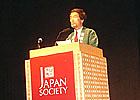
DAIMON SPEECH TO JAPAN SOCIETY
NEW YORK CITY, OCTOBER 12, 2000
LECTURE AND TASTING
SPEECH ENTITLED: Sake - Drink of the Gods, Drink for the People
LOCATION: At Japan Society, New York. NY
SPONSOR: Japan Society
CO-SPONSER: Sake Export Association
GUEST SPEAKER: Daimon Yasutaka, sixth-generation Japanese sake brewer, on behalf of the Japanese Sake Export Association (SEA), where he currently acts as one
of the directors. Also, John Guantner and other members of the Sake Export Association will join in the discussion.
TOPIC: Discussion about sake`s role as the ritual drink of choice at wedding feasts,
shrine festivals, building dedications, and elsewhere.
Greetings. I would like to first take the opportunity to thank everyone involved in allowing
us to be here tonight. And, on behalf of all the members of SEA, my fellow sake brewers, I would like to say that we consider it a great opportunity to be able to be here
to present to you not only our sake, which you hopefully have plenty of later, but also the history and culture and world that surrounds sake brewing in Japan. And of course, I
am also personally happy to have this chance to speak to you. So thanks, first of all, to Japan Society, and to all of you for being here tonight.
Naorai
Naorai is related to yearly festivals, called "matsuri" in Japanese, and refers to people first offering food and drink to the gods that reside in a Shinto shrine, and then taking
back and partaking of that food and drink themselves. Before I can explain what kind of deep meaning is involved here, it is necessary to explain a little bit about the concept of God in Japan.
Gods in Shinto, the Japanese religion, do not have a clear physical form. For this reason, in Shinto shrines, there is nothing like statues of Buddha, or Christ , or other
religious figures in human form enshrined in Shinto shrines. On the contrary, objects of worship in Shinto shrines, referred to as "Go-Shintai," are often objects like metallic
mirrors or swords into which a god that has come down onto the earth plane is temporarily residing. Other examples of such Go-Shintai include pieces of wood or
stone, and even a mountain or a waterfall can be a Go-Shintai for a Shinto shrine.
This is because the concept of god in Japan is based upon two elements, one being
"nature just as it is," and the other being "the souls of our ancestors." The concept of god in Japan is not that of an omnipotent creator of all things, nor is there anything
along the lines of doctrine, or the concept of any particular person being the founder of a religion. Another way to put it would be to say that the traditional religious beliefs of the
Japanese people are a based upon a mixture of respect for the abundance of nature, a fear of natural disasters, and respect for ancestors.
In Japan, religious festivals, called matsuri, are regularly-held events for expressing gratitude to gods that have come down to earth for the abundance of nature, - especially
harvest - and the birth of descendants, as well as for petitioning these gods for continued stability in life. Also, natural disasters are considered to be expressions of an
angry god or the roaming souls of ancestors. Occasionally, to quell these, special matsuri are sometimes held.

A Shinto shrine, again, called a Jinja in Japanese, is not where a god lives. It is
merely where a god comes down onto earth, and the object of worship called a Go-Shintai that is enshrined in a Jinja is where the god temporarily resides during the god
's stay on earth. Also, the verb "matsuru" means to create a place like this.
There are, in Japan, innumerable gods, gods of all kinds. There are also ancestral gods,
tied to bloodlines of families. Ancestral gods of families are referred to as Ujigami. Naturally, there are lots of Jinja, some large some small, in all locales in Japan. It is
even common to see Jinja on the roofs of tall buildings in big cities. And one jinja is not limited to a single god, but rather it is common to have several gods inhabiting any one single jinja.
Gods are also enshrined in the peoples' homes. Small shrines called kami-dana are built for this purpose. The same holds true for companies. Even those companies, hi
-tech and otherwise, for which Japan is most well-known almost always have small shrines in the company offices and factories.
Since the gods of Japan are based on nature and the souls of ancestors, it is possible
without denying that to accept the gods of other religions as well. And in actuality, there are many gods amongst those in Japan that have come from China and India.
Buddhism, too, was imported from China and India, and it is not uncommon in Japan to see a Buddhist temple within a Shinto shrine, sharing the same space. For example, in
Todaiji, a famous temple in Nara, every year in the middle of winter for one month, Buddhist monks partake in ascetic Buddhist religious exercises. To pray for the
success of these ascetic exercises, it has become a convention that the monks pray beforehand at a nearby Shinto shrine. This tight relationship between the gods of Japan and Buddhism is known as "Shinbutsu-shugou."
Returning now to the discussion about Naorai, as I mentioned before, special events and religious festivals, called matsuri, are regularly-held events for expressing gratitude
to gods that have come down to earth for the abundance of nature, - especially harvest - and the birth of descendants, as well as for petitioning these gods for continued stability
in life. Matsuri are held in every season, but by far the most important ones are held in the fall to give thanks for a successful rice harvest.
During a matsuri, food and drink are naturally prepared. That food and drink might include stalks of rice plants, rice itself, sake, meat and poultry, fish and shellfish, fruit,
grains, salt and water. In other words, the gifts of the sea and the gifts of the mountains. As these items of food and drink are the result of the abundance of nature, they have
come from god. And, in gratitude, they are offered back to the god with a prayer of "please, partake in these." Naturally, the god does not actually eat and drink these, but
they are offered with a spirit of modesty. In this way, these offerings of food and drink are infused with the blessing of that god, and filled with grace. Later, the people partake
of this food and drink and are themselves filled with the blessings and grace of god. This is what Naorai is all about. In a sense, Naorai can be described as gods and humankind eating and drinking together.
A matsuri is basically a religious event in which appreciation and respect are paid to the gods through a ceremony. The message of appreciation and respect is called
"norito." The menu of food and drink to be offered to the god is read as part of the norito. Since it is implicitly understood that the food to be offered will be eaten later, the fish,
poultry and meat can be cooked and properly seasoned beforehand.
It is unclear just when the practice known as Naorai, or customs similar to it, began. In
the Nihon Shoki, the oldest written account of history in Japan, written in the beginning of the 8th century, it is noted that it was a custom since before the 5th century to take
food and drink that had been offered to a god and partake of it in an all-night event. It seems, therefore, that this practice may have formed into a certain type of magic
incantation among the tribes that lived in central and western Japan between the 3rd and 5th centuries. The form of the ceremony changed over the subsequent 1500 years
but it has been passed down into modern Japan. In Japan on New Year's day, people gather with their families and eat special New Year's food, much of it consisting of
various stewed items. These are actually supposed to represent offerings to the god that has come to open the new year, and are later eaten by people. This too has its roots in Naorai.
Let's now look at a short video we have prepared that shows scenes of a festival at a shrine, prepared offerings of food and drink, and Naoria.
(Video of Iwashimizu Hachimangu, Iwafune Jinja, Go-Shintai, worshippers and
spectators going to the shrine, offerings within those Shrines, Naorai, etc.)
Well, since we have come all this way to pass on the culture surrounding sake to all of
you here in New York, let me say a few word about sake used in Naorai.
The most important of all the food and drink items offered to a god is sake. Sake itself if
a blessing from the gods, and it created by brewing rice, another gift from the gods. Not only that, the light inebriation we feel when we drink sake is a special feeling that can
be likened to being transported to another world, so it is viewed as a very special drink amongst the offerings.
This is why sake is indispensable to a matsuri. Also, the sake used in such matsuri is
even brewed at certain shrines as a ceremonial event. Looking at the written records remaining, the making of koji was done in the same way, but instead of using a
cultivated yeast and creating a highly concentrated yeast starter as is done today, natural yeast cells were allowed to float down into the mixture to ferment it. Also, since
the entire process only took four or five days, it was very sweet sake with a very low alcohol content. Much of the rice grain remained, and it was white and very cloudy. It is quite different from the sake we usually brew today.
It was considered that this kind of sake was very appealing to the gods. In actuality, it was likely that sake was offered to the gods because the people themselves liked it.
Then, through Naorai, the people could drink the sake. Then, it is thought, they could confirm their own existence as living in nature, or strengthen their awareness of their
identity as a member of their ancestral family or village.
Earlier, I mentioned that sake brewed for Naorai is significantly different from the sake that we brewers are making today. The methods we use today are much more
scientifically advanced, and refined flavors and fragrances in today's sake are the result. However, the fact that sake especially for Naorai is still brewed today indicates that we should not ever lose our respect for nature.
Thank you.
|