|
SAKE STORES
Top Menu
United States
Singapore
What is
Premium Sake
Serving Tips
Types of Sake 
Parameters
|
|
|
Brief Guide to
Premium Sake
Types / Grades

Click here
for a snapshot view
of most sake types

|
|
|
|

|
純米酒 JUNMAI:
rice only; no adding of distilled alcohol; generally a bit heavier and fuller in flavor than other types of sake, with slightly higher acidity; goes well with a wide range of food; in the past, at least 30% of the rice kernel had to be ground away during the brewing process to qualify as a Junmai. But the laws have changed, and Junmai can now be milled at any percentage, as long as the number is listed somewhere on the label.
|
|

|
本醸造酒 HONJOZO:
a tad of distilled alcohol is added; generally lighter than Junmai, and often very nice at room temperature or warmed; at least 30% of rice kernel is ground away during brewing process.
|
|

|
吟醸酒 GINJO:
highly milled rice, with or without added alcohol; the taste is layered and complex, light and fragrant; at least 40% of rice kernel is ground away during brewing process. Called Junmai Ginjo
when no alcohol is added.
|
|

|
大吟醸酒 DAIGINJO:
even more highly milled rice, again with or without added alcohol; the taste is even lighter and more fragrant and fruity than ginjo sake; at least 50% of rice kernel is ground away during the brewing process. Called
Junmai Daiginjo when no alcohol is added.
|
|

|
Some Ginjo and Daiginjo are also Junmai (i.e., a Junmai Ginjo is a Ginjo with no added alcohol). If a Ginjo or Daiginjo is not labeled Junmai, then the added alcohol is limited to the same small amounts as Honjozo.
|
|

|
Although each "type" has a general flavor profile, there is much overlap in taste elements. Very very often one cannot tell which type one is drinking, and therefore these "types" should only be considered as generalized
guidelines.
|
|

|
生酒 Namazake is sake that has not been pasteurized. It should be stored cold, or the flavor and clarity could suffer. Namazake has a fresh, lively touch to the flavor. All types of sake (junmai, honjozo, ginjo, and daiginjo) can be namazake, or not.
|
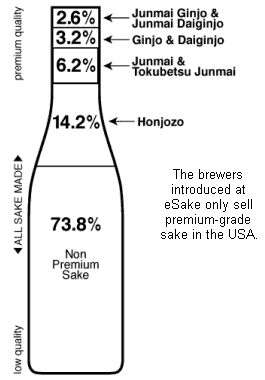
Premium versus Non-Premium Sake
Only the highest grades of sake are exported
to the USA by the brewers introduced at eSake.
Happy Sake Sipping !!
|